There's a moment almost every coffee lover has lived through. It's 8pm, you want that warm cup in your hands, that familiar aroma filling the kitchen, but you also want to fall asleep before midnight. So you reach for the decaf tin, and somewhere in the back of your mind you brace yourself. Because decaf has a reputation. Watery. Flat. Coffee-flavored water pretending to be coffee. A drink you settle for, not one you actually look forward to.
That reputation isn't really about decaffeination itself. It's about how most decaf has historically been made, and more importantly, what gets stripped out along the way. When you understand the difference between a rushed, over-processed decaf and one that's actually built with care, the whole category starts to look different. And once cardamom enters the picture, it looks different again.
This is the story of why decaf doesn't have to mean flavorless, and how Mazaj Decaf was built to prove it.
Where the "Decaf Tastes Bad" Reputation Actually Comes From
To understand why so much decaf falls short, it helps to understand what decaffeination actually does to a bean.
Caffeine doesn't exist on its own inside a coffee bean, it's tangled up with hundreds of other compounds that contribute to aroma, body, and flavor. Most commercial decaffeination processes use solvents, high-pressure water, or carbon dioxide to strip caffeine out of green (unroasted) beans before they're ever roasted. Cheap, fast methods tend to pull out flavor compounds along with the caffeine, which is exactly why so much drugstore decaf tastes thin, bitter, or oddly metallic.
There's also a sourcing problem. Because decaf has long been treated as an afterthought, the smaller shelf tag next to the "real" coffee, many brands use lower-grade beans for their decaf lines. Robusta instead of Arabica. Beans that didn't make the cut for the regular blend. The processing gets less attention because the assumption is that decaf drinkers aren't as picky. It's a self-fulfilling cycle: mediocre beans, aggressive processing, and low expectations combine to create the flat, forgettable cup that gave decaf its bad name in the first place.
None of that is inherent to decaffeination. It's a byproduct of how the category has been treated.
What Changes When You Start With the Right Beans
The starting point for any decaf worth drinking is the same starting point for any coffee worth drinking: quality beans, roasted with intention. Mazaj Decaf begins with the same Lebanese Arabica foundation used across the Yasma lineup, not a leftover grade, not a substitute bean chosen because "it's just the decaf." Arabica beans carry more of the aromatic oils and subtle sugars that give coffee its complexity in the first place, which means there's simply more good flavor available to protect during decaffeination.
That matters because gentler decaffeination methods preserve more of a bean's character, but they can only preserve what's there. Start with a thin, low-grade bean and even the best process gives you a thin, low-grade decaf. Start with real Lebanese Arabica, and the roast has something worth holding onto.
The other half of the equation is roast profile. Decaffeinated beans behave slightly differently under heat than regular beans, they roast faster and can scorch more easily if a roaster isn't paying attention. Mazaj Decaf is roasted at an intensity of 7 out of 10, deliberately calibrated to bring out body and richness without tipping into the burnt, over-roasted flavor that so much mass-market decaf leans on to compensate for what's missing.
The Cardamom Difference
Here's where Mazaj Decaf stops being "decent decaf" and starts being something genuinely worth reaching for.
Cardamom has been paired with coffee across the Middle East for generations, not as a novelty flavor, but as a natural complement that rounds out coffee's bitterness with warmth, a hint of citrus, and a subtly sweet, almost floral aroma. It's a tradition that predates the modern coffee industry entirely, and it works precisely because cardamom doesn't fight with coffee's flavor, it completes it.
That relationship becomes even more valuable in a decaf blend. Because decaffeination can mute some of a bean's natural aromatic complexity, cardamom fills exactly the gap that's most likely to go missing. The real green cardamom infused into Mazaj Decaf brings back the layers of aroma and warmth that make a cup feel full rather than diminished. Instead of a decaf that tastes like a compromise, you get a cup with a distinct identity, one that happens to also let you sleep at night.
This is also why "decaf cardamom coffee" is a genuinely useful thing to search for, rather than a contradiction. The two were never working against each other. Cardamom was solving the exact problem decaf coffee has struggled with for decades, long before anyone thought to put the two words together in a product name.
Built for the Moment Decaf Is Actually For
There's an honesty in naming what Mazaj Decaf is actually for: the parts of the day when you want the ritual of coffee without the side effects of caffeine. The after-dinner cup. The evening you're winding down with a book or catching up with someone at the table. The 3pm slump where another shot of caffeine would keep you up past midnight, but a plain herbal tea just doesn't scratch the itch.
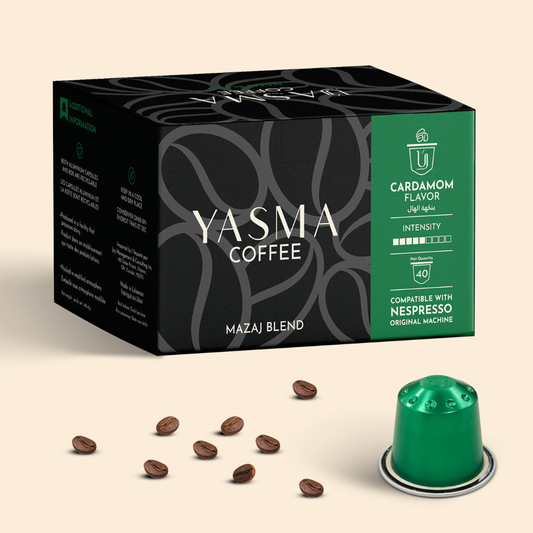
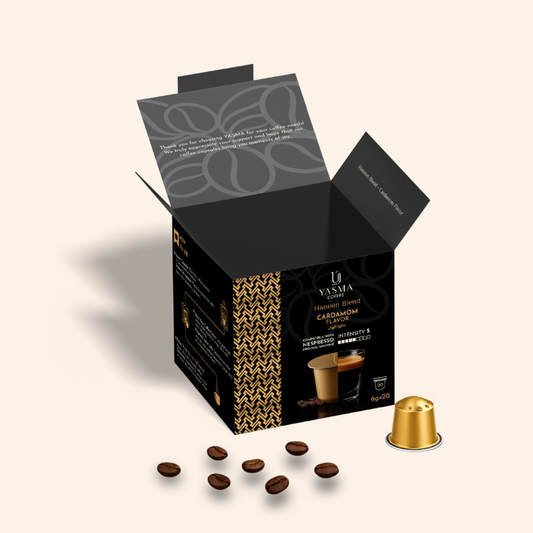
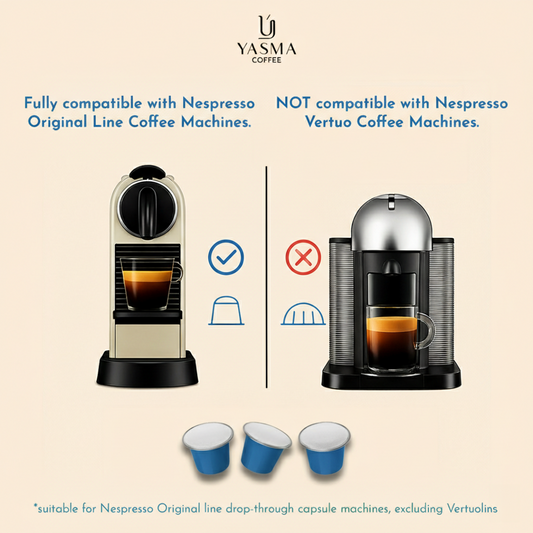
Nespresso Original Line-compatible capsules make that ritual effortless, the same machine, the same routine, the same intensity of espresso you'd pull any other time of day, just without the jitters afterward. There's no need to keep a separate decaf setup or plan your evening coffee differently from your morning one. Mazaj Decaf simply slots into the same rakwa-inspired ritual, so decaf stops being a downgrade and becomes just another way to enjoy the same coffee you already love.
For anyone managing caffeine sensitivity, pregnancy, sleep quality, or simply trying to cut back without giving up coffee altogether, that consistency matters. You shouldn't have to choose between "the coffee that tastes good" and "the coffee that lets me sleep." Mazaj Decaf is built on the idea that you don't have to.
How to Brew Mazaj Decaf for the Best Cup
A few small habits go a long way toward getting the most out of any cardamom-infused capsule, and Mazaj Decaf is no exception.
Use the espresso setting, not lungo. A shorter, more concentrated extraction captures more of the cardamom's aromatic oils rather than diluting them across a larger volume of water.
Store capsules somewhere cool and dry. Cardamom's aromatic compounds are sensitive to heat and light, so keeping capsules away from direct sun or a warm cupboard near the stove helps preserve that signature warmth until the moment you brew.
Try it as a latte. Steamed milk brings out the subtly sweet, floral edge of the cardamom even more than a straight espresso shot does, a Mazaj Decaf latte in the evening is a genuinely different (and quieter) experience than the same drink made with a caffeinated capsule.
Don't skip the aroma before you drink. Part of what makes cardamom coffee distinct is the smell that hits before the first sip. Give yourself a second to notice it, it's a big part of what separates this from the flat decaf you might be used to.
Decaf Deserves Better, and So Do You
The idea that decaf has to be a downgrade is really just a legacy of how the category was built, not a rule about what decaffeinated coffee is capable of. When you start with real Lebanese Arabica, roast it with the same care as any other blend, and bring in the centuries-old pairing of cardamom and coffee, you end up with a cup that has nothing to apologize for.
Mazaj Decaf isn't the safe, boring option on the shelf. It's the same ritual, the same intensity, the same distinctive Middle Eastern warmth as the rest of the Yasma lineup, just without the caffeine standing in the way of your evening. If your only experience with decaf has been the flat, forgettable kind, this is a good moment to find out what you've been missing.
Explore Mazaj Decaf and the rest of the Yasma Coffee capsule collection to find the blend that fits your ritual, whatever time of day it happens.