Walk into a Lebanese home, and before you've fully sat down, someone is already asking if you'd like coffee. It's not really a question. It's closer to a formality, the first small gesture in a much older tradition of hospitality that has very little to do with caffeine and everything to do with welcome.
Understanding that tradition is understanding a big part of what Lebanese coffee culture actually is.
Coffee as an offer, not a beverage
In many households across Lebanon and the wider Middle East, coffee, often called gahwa, is one of the first things offered to a guest. Refusing it outright can feel almost impolite, not because the coffee itself is so important, but because accepting it is a small acknowledgment of the welcome being extended. The cup itself is secondary to the gesture.
This is part of what makes Middle Eastern coffee ritual so distinct from a quick coffee break elsewhere. It's slower by nature. It's meant to be an excuse to sit, talk, and stay a little longer than you'd planned to.
Where cardamom fits into the tradition
Cardamom's place in Arabic coffee goes back generations, long before it became a flavor people search for online. In many households it wasn't an addition so much as an expectation, the thing that made coffee taste like home rather than just a hot drink. Its warmth softened the intensity of strong, dark-roasted beans and gave the coffee an aroma that could fill a room before the cup ever reached the table.
That's part of why cardamom and coffee are so tightly linked in Lebanese hospitality specifically. It's not decoration. It's tradition, carried forward one cup at a time.
The small rituals that come with it
A few details tend to hold true across most Lebanese households when it comes to serving coffee to guests:
- It's served in small cups, meant for slow sipping and conversation rather than quick drinking.
- It's rarely served alone. Coffee tends to arrive alongside a small plate of something sweet, and staying for a second cup is usually a welcome sign, not an imposition.
- Refilling is a gesture of warmth. A host offering a second cup is often a quiet way of saying they're glad you're still there.
- The coffee itself is almost secondary to the company. The point was never really the caffeine. It was always the sitting down together.
Why this matters for how we think about coffee at home
It's easy, especially with capsule machines and quick mornings, to treat coffee as something purely functional. Something you drink on the way out the door. There's nothing wrong with that, most days call for exactly that kind of coffee.
But there's something worth holding onto in the older version of the ritual too, the one where coffee is an invitation to slow down rather than speed up. Where making a cup for someone else is a small act of care, not just a beverage you're handing over.
A tradition carried into a modern cup
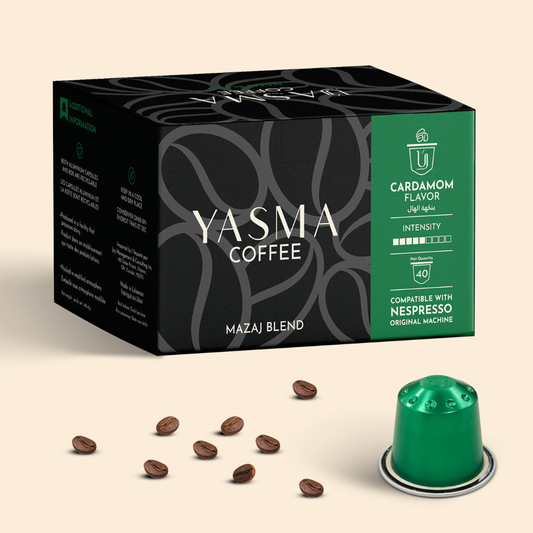
Yasma was named after a daughter, born out of one family's connection to Beirut and a desire to bring something genuinely rooted in that culture into everyday life in North America. Cardamom coffee, in particular, was never meant to be a novelty flavor. It's a direct line back to that tradition of hospitality, the coffee that says welcome before a single word does.
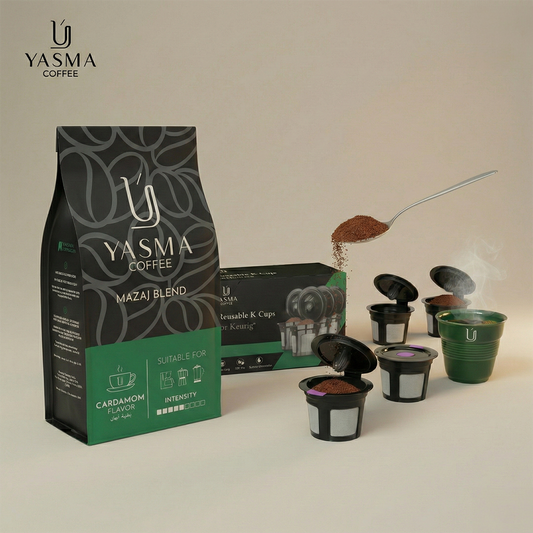
The next time you brew a cup of Mazaj Blend, consider making a second one. Not because you need the caffeine, but because that's always been at least half the point.